
Before an Indonesian essential oil reaches the global market, value can be added at many points along the supply chain. At the source. During trading. Through processing. Or closer to the final market. There is no single model that works for every ingredient. But for patchouli oil, we have chosen to take more of the processing further here in Indonesia.
From crude oil to a defined ingredient
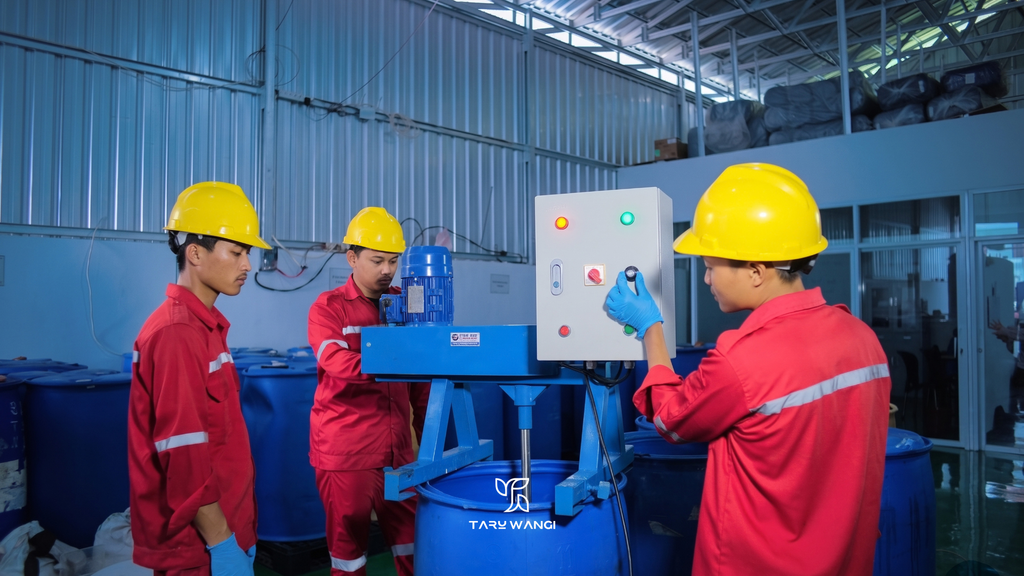
The crude patchouli oil we source comes to our facility in Yogyakarta. From there, it can go through different refining, distillation and fractionation processes depending on the characteristics and specification we are looking for. This is how we develop grades such as Molecular Distilled, Iron Free, and PA45, PA55 and PA65.
But refinement cannot fix everything. The quality and composition of the crude oil still matter. They influence how the oil behaves during processing, what can be achieved through refining, and ultimately the characteristics of the finished grade. This means that processing and sourcing cannot really be viewed as two completely separate activities. What happens in the refinery is partly connected to what comes in at the beginning of the chain.
What the market tells us
There is another side to this. When refined patchouli oil reaches different markets and is used by different partners, we gain a much clearer view of what is actually needed.
It may be a particular specification, a certain colour or compositional profile, better consistency from batch to batch, or a specific performance requirement. Sometimes it is also about understanding the challenges that users face when working with the material.
That information is valuable because it does not have to stop with the sales team or the refinery. It can make its way back to sourcing.
Bringing market needs back to the source
If a market requirement becomes more specific, the question at the beginning of the supply chain also becomes more specific. What kind of crude oil is needed? Which characteristics matter most? What can be improved in the raw material? And where could better consistency make a difference?
For a business that works closely with farmers, these questions can eventually influence how raw material is sourced and what kind of work may be useful at the source. That might mean refining sourcing criteria, paying closer attention to certain characteristics, sharing observations from the market, or developing programmes with farmers around areas that matter for the final ingredient.
The important point is that the information moves in both directions. Farmers and the source provide the raw material that makes processing possible. Processing helps us understand the material more deeply. And working with the international market gives us feedback that can, in turn, inform what happens at the source.
Keeping the loop connected
Value addition, then, is not only about turning crude oil into a higher-value product. It is also about creating a stronger connection between the beginning and the end of the supply chain. For patchouli, keeping sourcing and processing connected in Indonesia gives us the opportunity to learn from both sides: from the raw material itself and from the people using the refined ingredient.
The refinery is one part of that process. The real value comes from keeping the information moving between the source, the processing stage and the market. That is the kind of connection we want to keep building as we continue to work with patchouli.