
One of the main concerns with iron is its potential effect on colour and stability. This can become more noticeable when patchouli oil is used in products where a clean, light, or clear appearance is important. For example, a small change in the raw material may be easier to notice in a white cream or clear formulation. This is why knowing the iron level of the patchouli oil can be useful when selecting a raw material for a particular application.
But how do we know how much iron is actually in the oil?
Looking at the colour is not enough. Visual inspection can tell us that two samples look different, but it cannot tell us whether one contains 2 ppm of iron and another contains 5 ppm. This is where analytical testing becomes important. By measuring the iron content, we can move from a visual observation to an actual number that can be compared with a specification.
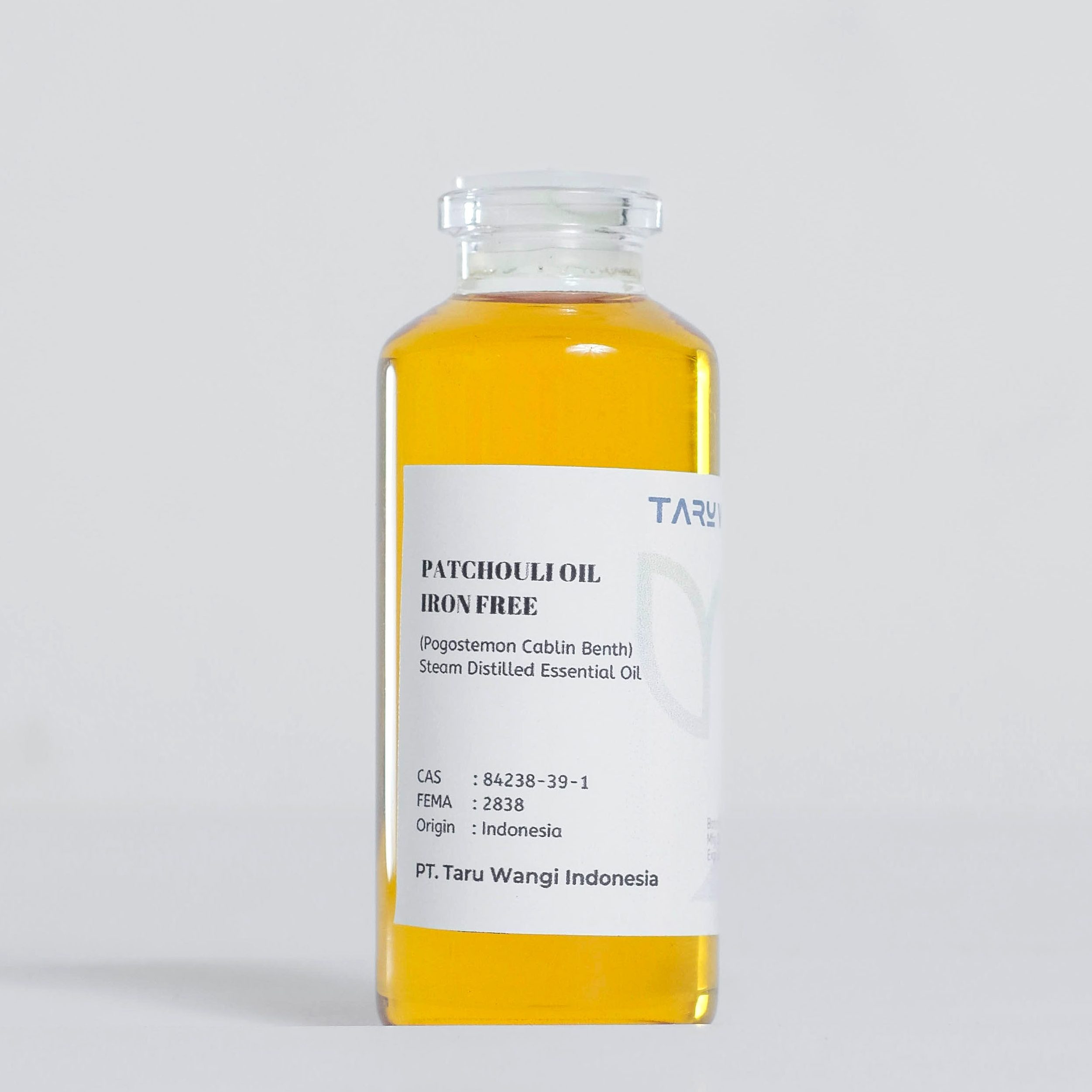
From Visual Checks to Measurable Data
There are different analytical methods that can be used to measure metals. For our Iron-Free grade, we use Atomic Absorption Spectroscopy (AAS) to determine the iron content at low levels. The principle is quite straightforward. After the sample is prepared, it is introduced into the instrument and converted into free atoms. A light source then passes through the sample at a wavelength specific to iron.
Iron atoms absorb part of this light. The instrument measures the amount of light absorbed and uses the result to calculate the iron concentration in the sample. The final result is given as a numerical value, usually in parts per million (ppm). This gives us something more useful than simply saying that an oil has “low iron” or “looks clean.”
For our Iron-Free patchouli oil, the maximum iron specification is 5 ppm. The test result can then be compared with this limit to confirm whether the batch meets the specification.
Testing Is Only One Part of the Process
Measuring the finished oil is important, but testing is only one part of controlling iron. The production process, oil transfer, handling, and storage conditions also need attention. For us, quality control is not only about testing a finished batch. It is also about understanding where variation can come from and keeping those factors under control throughout the process.
This becomes particularly important for a grade with a defined specification, such as Iron-Free patchouli. The goal is not simply to produce an oil that looks light when it is packed. We want a product with a clear specification and analytical data to support it.
In the end, “Iron-Free” should be more than a name on a product list. There should be a specification behind it, testing to support it, and a process that helps keep the result consistent from one batch to the next.