
When buyers request dark or light patchouli oil, the expectation often seems straightforward. However, these terms can mean different things to different suppliers. One supplier’s “light” may appear noticeably darker than another’s. While both may meet their own internal standards, the difference can create confusion during sourcing or quality control. This is why understanding patchouli oil color and how to measure it objectively is becoming increasingly important.
Why Does Patchouli Oil Come in Different Colors?
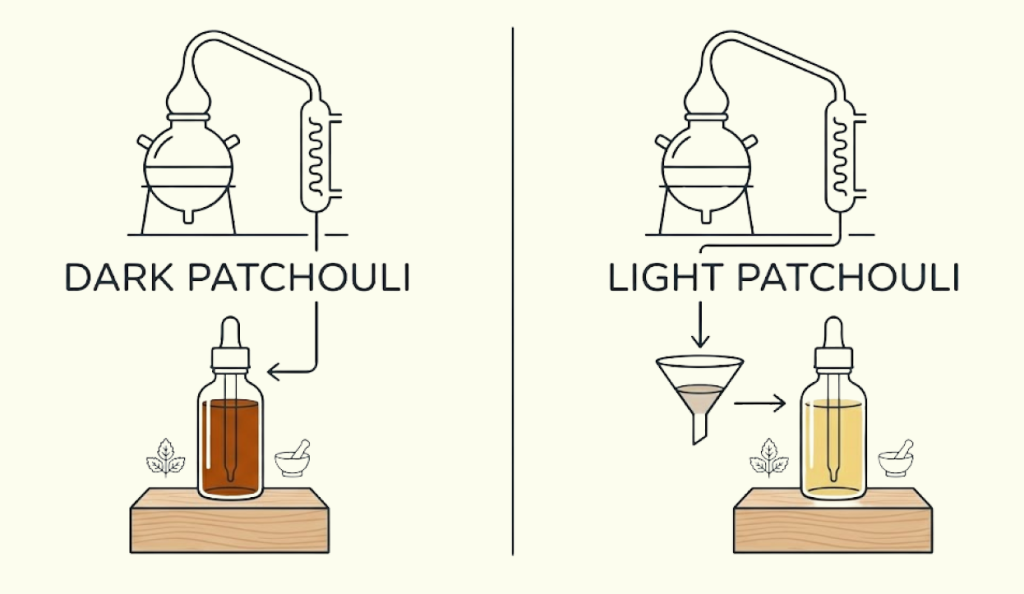
The difference is not the patchouli plant itself. Freshly distilled patchouli oil naturally has a darker amber appearance because it still contains color compounds formed during steam distillation. To produce a lighter oil, manufacturers apply additional refining processes that reduce these compounds while preserving the characteristic patchouli aroma.
Some applications require even greater color stability. In those cases, iron-free patchouli oil undergoes an additional de-ironization process to help maintain a cleaner appearance over time.
Does a Lighter Color Mean Better Quality?
Not necessarily. Color reflects how the oil has been processed, but it does not define its quality. Experienced buyers evaluate patchouli oil based on several factors, including aroma profile, Patchouli Alcohol (PA) content, stability, and consistency, not color alone.
In other words, dark and light patchouli oils simply serve different purposes.
When Is Dark or Light Patchouli Preferred?
Dark patchouli oil is often selected when a rich, earthy character is desired, such as in oriental fragrances, woody accords, candles, or soaps. Light and iron-free grades are commonly preferred for products where appearance matters, including clear perfumes, white creams, lotions, and transparent serums. The right choice depends on your formulation rather than which grade is considered “better.”
Why Color Should Be Measured, Not Described
Describing a sample as light yellow or pale amber leaves room for interpretation. For routine applications, this may not be an issue. However, manufacturers with strict color specifications often require a more objective approach. Using measurable color values helps suppliers and buyers communicate with the same reference. It also improves batch-to-batch consistency and reduces the risk of misunderstandings during quality control.
Common color parameters include Gardner Color and CIELAB (L, a, b*) values**, both of which provide a standardized way to define color instead of relying on visual judgment.
How Taru Wangi Supports Color Specifications
At Taru Wangi, we evaluate patchouli oil color using a colorimeter, allowing us to provide objective color measurements rather than visual descriptions alone. Depending on customer requirements, we can provide Gardner Color or CIELAB (L, a, b*) values** alongside our standard quality documentation.
Whether you require a general color range or a specific target value, measurable data helps ensure greater consistency from batch to batch.
When color plays an important role in your finished product, objective measurement provides a clearer specification than visual observation alone. By defining color with measurable parameters, buyers and suppliers can communicate more precisely, improve consistency, and reduce uncertainty throughout the supply chain.