
Imagine receiving two patchouli oil samples.
Both contain 35% Patchouli Alcohol (PA). Both meet the same specification. Both originate from Indonesia.
Yet when you smell them side by side, they are clearly different. One feels dry, woody, and elegant. The other is richer, sweeter, and more rounded. So what happened? If the PA content is identical, shouldn’t the aroma be identical as well?
Not necessarily.
While Patchouli Alcohol is one of the most important quality indicators in patchouli oil, it is only one part of a much larger aromatic picture.
PA Is Important, But It Is Not the Whole Story
Patchouli oil is a naturally complex material. In addition to Patchouli Alcohol, it contains dozens of other compounds that contribute to its overall aroma profile. Some enhance woody notes. Others contribute earthy, sweet, spicy, or balsamic nuances. Together, these compounds create the character that perfumers experience when evaluating an oil. This means two patchouli oils can contain the same percentage of PA while still smelling noticeably different.
Think of it like coffee. Two coffees may contain the same amount of caffeine, yet taste completely different depending on the beans, roasting process, and brewing method.
Patchouli oil works in a similar way. PA is important, but it does not define the entire sensory experience.
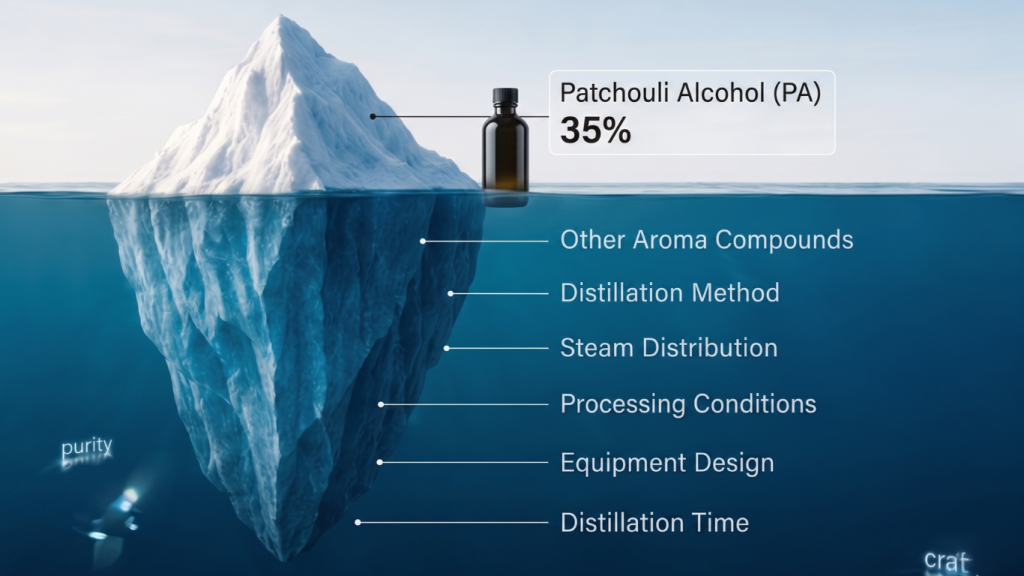
What Creates the Difference?
One of the biggest factors is how the oil is produced.
The distillation process influences which compounds are extracted and in what proportions. Variables such as distillation time, steam distribution, condenser efficiency, and equipment design can all affect the final composition of the oil.
Even when the resulting PA content remains similar, the balance of other aroma-active compounds may be different. In practice, small variations during processing can lead to surprisingly noticeable differences in aroma. This is why two patchouli oils with the same PA content may not smell the same.
Why Perfumers Still Rely on Their Nose
Analytical data plays an essential role in the fragrance industry. It helps verify quality, authenticity, and consistency. However, a specification sheet has its limitations. A laboratory report can tell you what is present in an oil. It cannot fully describe how that oil will smell in a fragrance formula. For this reason, experienced perfumers rarely evaluate patchouli oil based on analytical results alone. Sensory evaluation remains an important part of the process because aroma, character, and performance cannot always be captured by numbers. The nose still matters.
Looking Beyond the Numbers
Patchouli Alcohol will continue to be one of the most valuable indicators of patchouli quality. But evaluating patchouli oil based solely on PA content can oversimplify one of nature’s most complex aromatic ingredients.
Two oils may share the same PA content, yet offer completely different sensory experiences.
At Taru Wangi, we believe that understanding patchouli requires both science and sensory expertise. Laboratory analysis helps us verify composition and consistency, while sensory evaluation helps us understand the character behind the numbers.
Because in the end, the most important question is not only how much PA a patchouli oil contains. It is how the oil smells.